01
Measure often
1,000 samples per second on every axis, so the fastest parts of a lift are not missed.

TECHNOLOGY · VBT SENSOR
A wireless sensor that attaches to the bar and records its movement 1,000 times per second. It is MOOVIA's first device and the data source for the platform.
VBT IN ONE MINUTE
Velocity-based training (VBT) uses the speed at which you move the bar to adjust the day's load.
With the same weight, if the first rep moves slower than usual, today it is costing you more. If velocity drops a lot within a set, fatigue is building up. Measuring it turns a feeling into a number you can compare with last week's.
HOW IT WORKS
01
It goes on the end of the bar. No cables.
02
The sensor streams the signal to your phone over Bluetooth while you lift.
03
When you finish, the app counts the reps, calculates their metrics and keeps the full signal.
FIGURES
This is what the sensor measures today, with its source and date. When the hardware changes, this table will change.
| Item | Value |
|---|---|
| Sampling rate | 1000 Hz |
| Axes | 6: 3-axis accelerometer and 3-axis gyroscope |
| Accelerometer range | ±8 g |
| Gyroscope range | ±1000 °/s |
| Connection | Bluetooth Low Energy, 15 samples per packet |
| Capture integrity | 0 samples lost in two captures of 69.4 s and 66.8 s (22 October 2026) |
| Raw signal | Kept in full with every set and exportable as JSON |
| Battery | Rechargeable via USB-C |
Current prototype, October 2026. The next version of the sensor is being designed: components and ranges will change, and this table will be updated with its tests.
METRIC STATUS
Every metric has a status. It only becomes “verified” once we have checked it and can say against what and when.
DATA QUALITY
01
1,000 samples per second on every axis, so the fastest parts of a lift are not missed.
02
If a stretch of signal is lost, it is marked as a gap: it is not silently filled in and time is not compressed.
03
Every set keeps the raw signal. If we improve an algorithm tomorrow, your set can be recalculated.
04
Every metric says whether it is verified, in validation or in development, and since when. What we measure is public; how we calculate it is not.
TEST LOG
The tests behind the figures on this page, newest first.
| Date | Test | Result | Status |
|---|---|---|---|
| Date: | Test: Capture integrity | Result: 0 samples lost in two captures of 69.4 s and 66.8 s, checked against the sensor's internal timestamp | Status: Verified |
| Date: | Test: Continuous streaming on the bench, sensor at rest | Result: 0 samples lost in about 2 minutes | Status: Verified |
| Date: | Test: App-to-sensor connection | Result: The app connects, sends commands and receives the signal in real time | Status: Verified |
| Date: Next | Test: Vertical range of motion against heights measured on the rack; set-by-set comparison with a commercial VBT system | Status: Pending |
Tests carried out before 22 October 2026 will be repeated: they used a firmware version that dropped samples.
Does your lab have reference equipment? Propose a collaboration
Our dated timelineDEVICES
The bar sensor is MOOVIA's first device. The next ones will follow the same standard: publish what they measure, with which figures and the status of every metric, before asking you to trust them.
The platform that will use this dataINSIDE
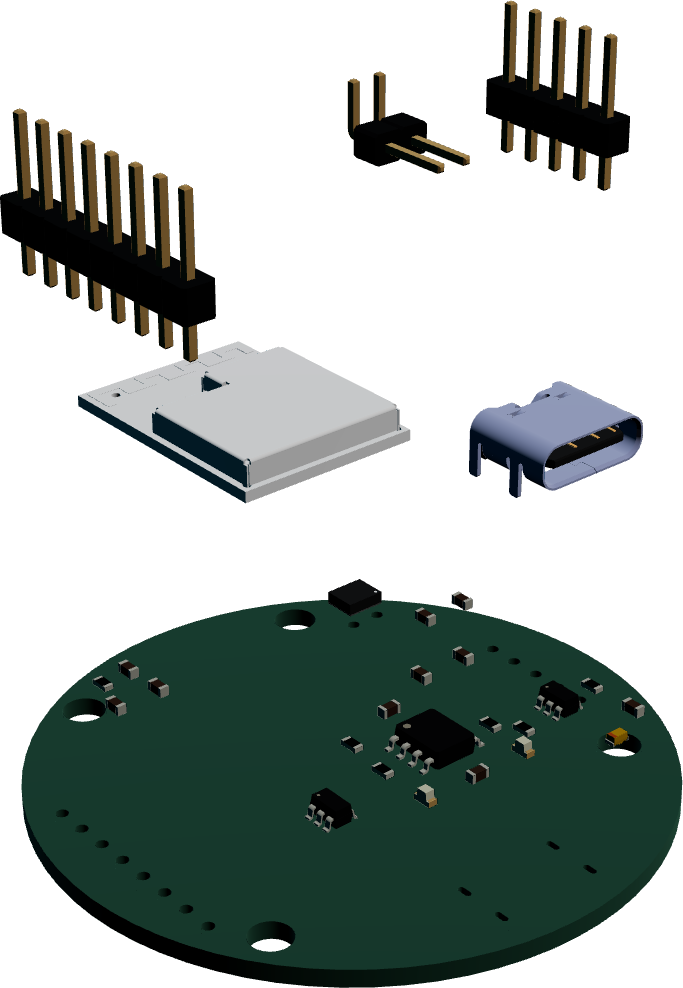
What you see is the actual prototype board, exported from the electronics design project. It is not a catalogue render.
01
Programming and debug headers. This is how we flash the firmware and probe the sensor bus on the bench.
02
Battery charging and power during lab tests.
03
It reads the IMU, packs the samples and sends them to the phone.
04
The heart of the measurement: accelerometer and gyroscope at 1000 Hz. Every rep's velocity starts here.
05
Regulation, filtering and protection: the part nobody sees, and the one that decides whether the signal is clean or noise.
06
Designed by us, with a continuous ground plane so the board does not pollute the sensor signal.
Development revision: the programming headers are exposed because this is the board we test the sensor with. The next version is being designed.
It is training that uses bar velocity to adjust load and manage fatigue: with the same weight, if the bar moves slower than usual, today it is costing you more.
1,000 times per second on each of its 6 axes (accelerometer and gyroscope). In the tests of 22 October 2026, two captures of 69.4 s and 66.8 s, no samples were lost.
We do not publish an accuracy figure for velocity yet: it is in validation. We do publish the sampling rate, the ranges and the capture integrity, with their dates.
Rep counting has had its own mode for the Olympic lifts since 24 October 2026. Their velocities are in validation and their phase-by-phase metrics are in development.
No. 2D or 3D bar path has been out of scope since 25 October 2026. Today we measure vertical displacement.
Yes. The test app exports every set with the raw signal as JSON.